

Iran and US Deal to End War: What’s at Stake in 2026
페이지 정보

본문
Iran and US Deal to End War: What’s at Stake in 2026

The Chokepoint at the Centre of Everything
Few geographic features carry as much economic weight as a strait that can be crossed in minutes but whose disruption sends shockwaves through every fuel-dependent economy on earth. The Strait of Hormuz, a narrow passage between Iran and Oman, sits at the intersection of energy security, nuclear politics, and great power rivalry in a way that no other waterway does. When it functions normally, roughly one-fifth of global oil exports pass through it daily. When it does not, the consequences extend from European petrol forecourts to Asian manufacturing supply chains within weeks.
The events of early 2026 brought that vulnerability into sharp focus. A sequence of military operations, ceasefire negotiations, port blockades, and diplomatic back-channels has produced what may, depending on the next several weeks, either become a landmark de-escalation between Washington and Tehran or another chapter in their decades-long strategic confrontation. Understanding the current Iran and US deal to end war requires moving beyond the headline figures and examining the structural forces that have shaped this moment, and the multiple scenarios that still lie ahead.
Why This Moment Is Structurally Different From Previous Negotiations
The Long Shadow of the JCPOA's Collapse
By 2026, Iran's uranium enrichment had advanced significantly beyond 2015 levels, the inspection regime had effectively collapsed, and the conditions for conventional diplomacy had been replaced by direct military confrontation. Furthermore,uranium market volatilityhad already been reshaping investor expectations well before the conflict escalated. Any new framework, therefore, must not merely replicate the 2015 structure but address why that structure failed to create durable incentives for compliance on both sides.
The distinction between the current draft memorandum of understanding and a binding treaty is not a legal technicality. It is the central structural feature of the negotiation. A memorandum carries no enforcement mechanism under international law, meaning compliance depends entirely on the political will of both administrations, which is itself subject to domestic pressures, electoral cycles, and leadership continuity in both Washington and Tehran.
A Timeline of Escalation and Opening
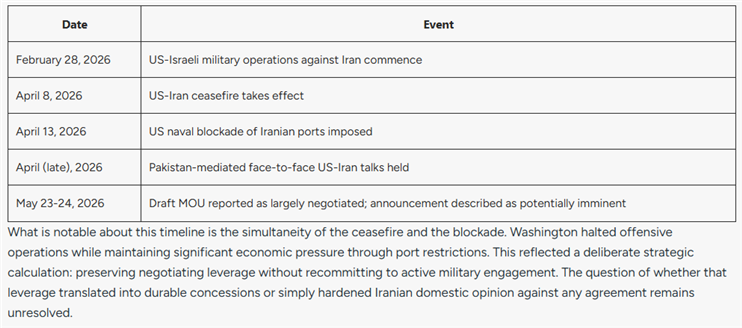
(…Further details omitted…)
(BY Muflih Hidayat / Discovery Alert, On May 25, 2026)
Iran-US Deal to End War: Key Terms Explained
- 다음글해군의 미래·전투력 핵심 439명 힘찬 첫발 내딛다 26.05.21
댓글목록
등록된 댓글이 없습니다.